
Black Pudelpointers: Why They’re So Rare and So In Demand
By Chris Wilson, Owner & Head Trainer, Granite Ledge Kennels
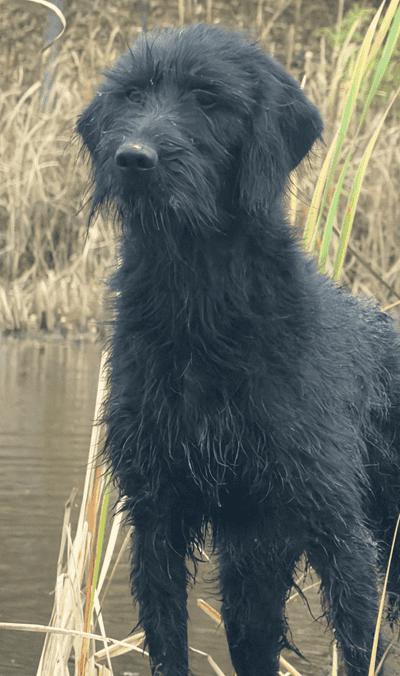
If you’ve spent any time around Pudelpointers, you know the look: a harsh, wiry coat in some shade of brown, a bearded face, and eyes that are already watching the cover for birds. What you probably haven’t seen much of is a black one. That’s not an accident. Only about 5% of Pudelpointers are black, and in my experience they’re one of the most asked-about dogs in the breed.
I get calls every season from hunters who have seen a black Pudelpointer once — at a NAVHDA test, in a duck blind, on someone’s Facebook page — and haven’t stopped thinking about it since. So I wanted to put down what I know about black Pudelpointers, why they’re so uncommon, and what I tell people who are set on one.
Brown is the norm, black is the exception
The Pudelpointer goes back to 1881, when Baron von Zedlitz in Germany set out to cross the standard Poodle with the English Pointer. It took him roughly 30 years and about 11 Poodles to 80 Pointers to lock in what he wanted: one dog that could point upland game and retrieve from water with equal skill. (You can read more of that history on our Pudelpointer breed page.)
The coat that came out of that cross is harsh, wiry and dense, and it’s brown in the vast majority of dogs — anywhere from a light “dead grass” shade to a deep liver. Black has always been part of the breed, but it’s the occasional dog, not the standard one. Out of every 20 Pudelpointers you meet, you might see one that’s black.
Why black Pudelpointers are so rare
It comes down to genetics and to how few breeders keep black in their program.
In dogs, black is dominant over brown. A brown Pudelpointer carries two copies of the brown gene, so when you breed two brown dogs together, every puppy comes out brown. There’s no hidden black waiting to show up. To get a black puppy, at least one parent has to be black.
Since the large majority of the breed is brown, black dogs are a small slice of the breeding population to begin with. And a responsible breeder isn’t going to pair two dogs just for color. At Granite Ledge, every breeding decision starts with hunting ability, temperament and health. If a black dog doesn’t also bring a strong nose, natural point, cooperation and clean health testing, it doesn’t belong in the program — no matter how good it looks. That keeps the number of black litters low, and the number of black puppies even lower.
Why hunters want them
Part of it is simply that they’re striking. A black, wire-coated Pudelpointer locked on point in October grass or swimming back through a cattail marsh with a drake stops people in their tracks. When something is rare and good-looking, people want it.
But the hunters I talk to usually have practical reasons too:
- They stand out in the uplands. A black dog is easy to pick up against tan grass and early snow.
- They match the marsh. Waterfowl hunters like how a dark dog disappears into the blind.
- They’re still a Pudelpointer. You get the same low-shedding coat, the same easy grooming, the same family temperament, and the same versatile ability the breed is known for.
That last point is the one I want to drive home.
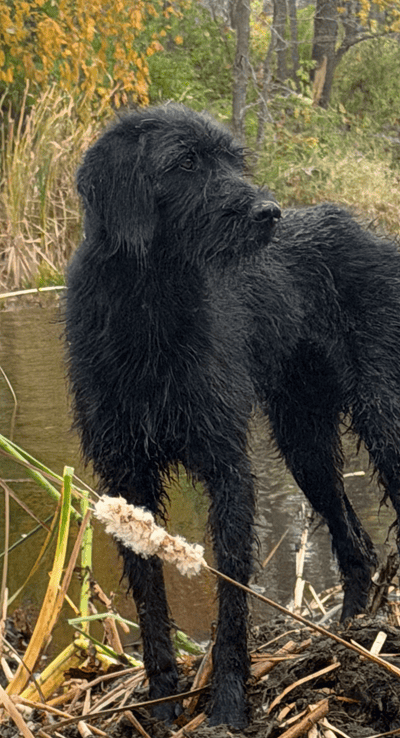
Color is a bonus, not a reason
A black Pudelpointer doesn’t hunt any harder, point any steadier or track any better than a brown one. Coat color has nothing to do with nose, drive or brains. Those come from the parents and from training, and that’s where I’d tell anyone to focus first.
When you’re looking at a litter, black or brown, here’s what actually matters:
- Proven parents. Look for real field credentials — NAVHDA Natural Ability and Utility results, German VJP and HZP scores — not just a pretty pedigree. Our sire, Iggy (Ignatz vom Werschehof), was imported from Germany and earned a NA 112 Prize 1 and a UT Prize 2, along with VJP 65 and HZP 186.
- Health testing and a written guarantee. Every Granite Ledge litter comes with a written health guarantee, including EIC (Exercise-Induced Collapse) testing.
- Temperament. A Pudelpointer should be just as good on the couch as in the duck blind. Ask to meet the parents.
- A breeder who hunts and trains. I’ve been training gun dogs professionally for over 20 years on our 180 acres near Milaca, and the same dogs I train are the bloodline I breed. That’s how you know the traits are real.
If a black pup comes along with all of that, you’ve got something truly special. If you skip any of it for the sake of color, you’ve just got a black dog.
The versatile dog underneath the coat
Whatever the color, this is a breed built to do a hunter’s whole job. Pudelpointers point upland birds, retrieve from cold water, and take naturally to scent work — which is why I use them for blood trail tracking to recover wounded deer. If you want to dig deeper, check out our posts on Pudelpointer hunting abilities and Pudelpointer hunting style.
Black puppies are coming to Granite Ledge
Here’s the news a lot of you have been waiting for: our upcoming litters are expected to include a few black Pudelpointers. We’re mapping out our 2027 breeding plans right now, and these black pups will come from the same health-tested, field-proven lines as every dog we raise — bred first for nose, point, cooperation and temperament, with the color as a bonus.
There will only be a few, and black puppies in this breed tend to be spoken for fast. If a black Pudelpointer is what you’re hoping for, reach out now and let me know. I’ll be straight with you about what each litter is likely to have and where you’d stand.
New litters are announced first on our Facebook page, so follow us there. Or give me a call at (612) 490-4802 or email chris@graniteledgekennels.com. I always enjoy talking dogs — especially Pudelpointers.
— Chris
Ready to talk about your dog?
Training openings, tracking calls, and Pudelpointer litters are limited — reach out and we’ll figure out the right fit. 14065 185th Avenue NE, Foreston, MN 56330.