
Almost every week, someone calls me with the same question: “I’m trying to decide between a Pudelpointer and a Drahthaar. Which one should I get?”
It’s a fair question. Both breeds come from Germany. Both wear a wiry, weather-proof coat. Both are expected to point birds, retrieve from water, and track wounded game. Standing in a field, a lot of people can’t tell them apart.
I breed Pudelpointers here at Granite Ledge, so you might expect me to just tell you to buy one of mine. I won’t. I’ve spent more than twenty years training gun dogs for a living, and versatile breeds of every kind have come through my program. Both of these are excellent dogs. They’re just not the same dog, and the right one depends on you. Here’s how I explain the differences to the people who call me.
They Share a Family Tree
Most folks are surprised to learn how closely these breeds are related. The Pudelpointer came first. Baron von Zedlitz started the breed in 1881, crossing the Poodle’s brains and love of water with the English Pointer’s drive and nose.
A few years later, the German breeders who built the Drahthaar pulled from the best wire-coated dogs they could find. The Pudelpointer was one of them, along with the Griffon, the Stichelhaar, and the German Shorthair. The Verein Deutsch-Drahthaar (VDD) was founded in 1902 to guide the breed. So when you look at a Drahthaar, you’re often looking at a little Pudelpointer, too.
Drahthaar or German Wirehaired Pointer?
You’ll hear “Drahthaar” and “German Wirehaired Pointer” used like they’re the same thing. In North America, they usually aren’t. A Deutsch Drahthaar is bred under VDD rules, and both parents have to pass hunting tests plus health and temperament checks before a litter can be registered. A German Wirehaired Pointer is usually AKC-registered, where field testing is encouraged but not required for breeding.
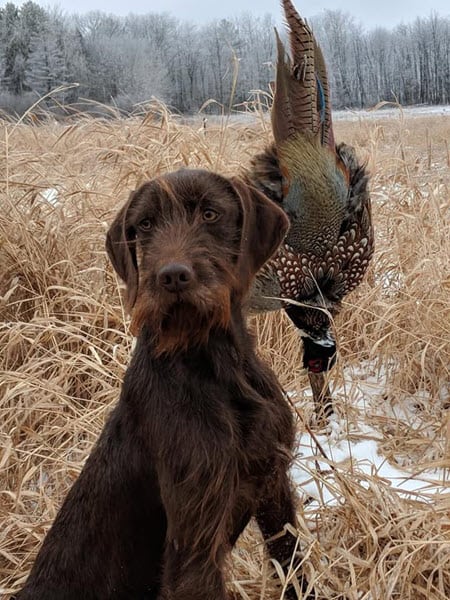
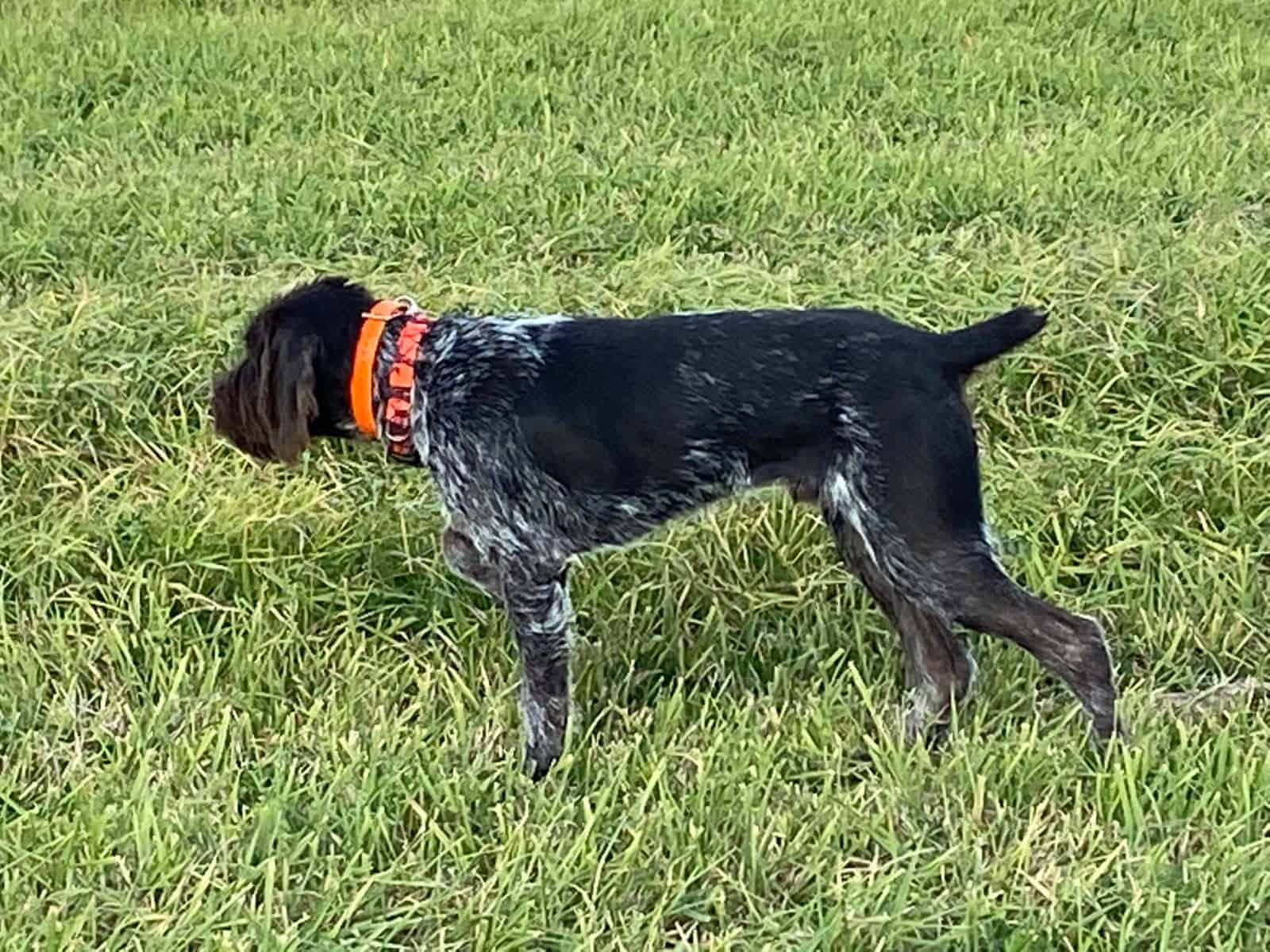
I hold my own breeding program to the same idea. The dogs I breed have to prove themselves in the field, not just on paper. Whatever breed you pick, ask the breeder to show you what the parents have actually done.
Side by Side
| Pudelpointer | Deutsch Drahthaar | |
|---|---|---|
| Origin | Germany, 1881 (Poodle × English Pointer) | Germany, late 1800s (Griffon, Stichelhaar, Pudelpointer, Shorthair) |
| Size | About 21–26 in., 40–70 lb. | Similar height, often heavier-boned |
| Coat | Harsh, wiry, low-shedding; can vary within a litter | Harsh, wiry, generally more uniform |
| Temperament | Soft, people-focused, eager to please | Confident, tougher, often reserved with strangers |
| Training feel | Responds best to calm, consistent handling | Handles more pressure; can be strong-willed |
| Range | Moderate, works with the handler | Moderate to farther |
| Water | Excellent | Excellent |
| Tracking | Strong natural ability | Strong natural ability; core to German testing |
| Home life | Easy, affectionate house dog | Good family dog with an owner who sets clear rules |
Temperament Is the Big Difference
If you take one thing away from this, make it this: in my experience, the Pudelpointer is the softer, more cooperative dog, and the Drahthaar is the harder one.
You can see the Poodle in a Pudelpointer the first week you train one. They watch you. They pick up on your tone. They want to get it right, and most of them would rather work with you than off on their own. That’s a big part of why I chose this breed for my own program. It’s also why I tell clients that heavy-handed training will backfire on a Pudelpointer. Raise your voice too often and a sensitive dog will quit on you for the day.
The Drahthaar was built for German hunters who wanted a dog that could handle anything in the forest, foxes included. A good Drahthaar is confident, tough, and steady, and many are naturally watchful around strangers. The VDD pulls dogs with unwarranted aggression out of breeding, and a well-bred Drahthaar makes a fine family dog. In my experience, they just do best with an owner who’s comfortable being firm and consistent.
Neither temperament is better. It comes down to what kind of handler you are.
Coat and Grooming
Both breeds wear a wire coat that sheds burrs, cattails, and cold water. The Drahthaar’s coat tends to be more consistent from dog to dog, after more than a century of selection for it.
Pudelpointer coats can vary more, sometimes even within a litter. Some dogs carry a tight, harsh jacket; others come out a little softer or with more furnishings on the face. Coat is one of the things I watch most closely when I plan a breeding, because a poor coat is a real problem in a Minnesota marsh in November. Either breed needs little more than a weekly brushing and a burr check after the hunt. And since the Pudelpointer sheds so little, I hear from a lot of families with mild allergies who do well with one.
In the Field
On upland birds, both breeds hunt at a moderate, practical pace. That suits the grouse woods and walk-up pheasant cover we hunt here in central Minnesota. Neither one is a big-running field trial dog, and that’s on purpose.
In the marsh, both are tough. A well-bred Pudelpointer loves water, and you’ll see that Poodle retrieving desire every time a bird hits the water. Drahthaars are just as hardy and often carry a bit more mass, which can help in big, cold water late in the season.
On a blood trail, both are excellent. Tracking is a core part of German testing, and both breeds were shaped by it. It’s a big reason I built a blood trail tracking program alongside my bird dog work.
What Training Looks Like
The Pudelpointers in my program learn fast and remember well. Short, upbeat sessions work best, and they often pick up things like steadiness and handling earlier than people expect. The hard part is patience. If you push too hard, a sensitive dog can shut down.
The Drahthaars I’ve trained learn quickly too, but they tend to test the rules more, especially as teenagers. They take correction better and bounce back fast. An owner who’s consistent and fair does great with one.
Feeding time is a great opportunity to for a training sessions focused on simple obedience commands.
Honestly, with either breed, what you do in the first year matters more than which breed you picked. That’s why I train one dog at a time, with a plan built for that dog. You can see how I do it on my hunting dog training page.
So Which One Should You Get?
Here’s what I tell people on the phone.
A Pudelpointer is probably your dog if:
- You want a hunting partner that’s also an easygoing family dog
- You like a dog that’s eager to please and responds to a light touch
- You hunt upland birds, ducks, and deer and want one dog for all of it
- Someone in the house has mild dog allergies
A Drahthaar is probably your dog if:
- You want a tougher, more independent dog with natural guarding instincts
- You’re an experienced, confident handler who enjoys a strong-willed dog
- You do a lot of big-water or predator-heavy hunting
- You want a coat that’s very consistent from dog to dog
Give Me a Call
The best way to decide is to meet both breeds and talk to people who actually hunt and train them. I’m happy to share what I’ve seen, even if a Pudelpointer turns out not to be your dog.
If it is, my litters come from health-tested, German-imported bloodlines, and every puppy comes with a written hip and eye guarantee. I announce new litters on our Facebook page first.
Call me at (612) 490-4802 or email chris@graniteledgekennels.com.
— Chris Wilson, Owner & Head Trainer, Granite Ledge Kennels
Ready to talk about your dog?
Training openings and Pudelpointer litters are limited — reach out and we’ll figure out the right fit. 14065 185th Avenue NE, Foreston, MN 56330.
Pingback: Pudelpointer Breeders in MN: How to Compare Your Options - Professional Hunting Dog Trainer & Pudelpointer Breeder